Who we are
About Llumàtics
Llumàtics exists to share the passion for real photography with people who feel it the same way. We’ve been doing and teaching analogue photography for many years — long before hipsters made it fashionable a decade ago. We didn’t come from a trend. We came from a necessity.
Where we come from
Joan Linux Martínez (Barcelona, 1972) grew up in a family of artists: ceramicists, sculptors and painters. That environment gave him, from a very early age, access to a reflex camera and a first glimpse of what would become his life.
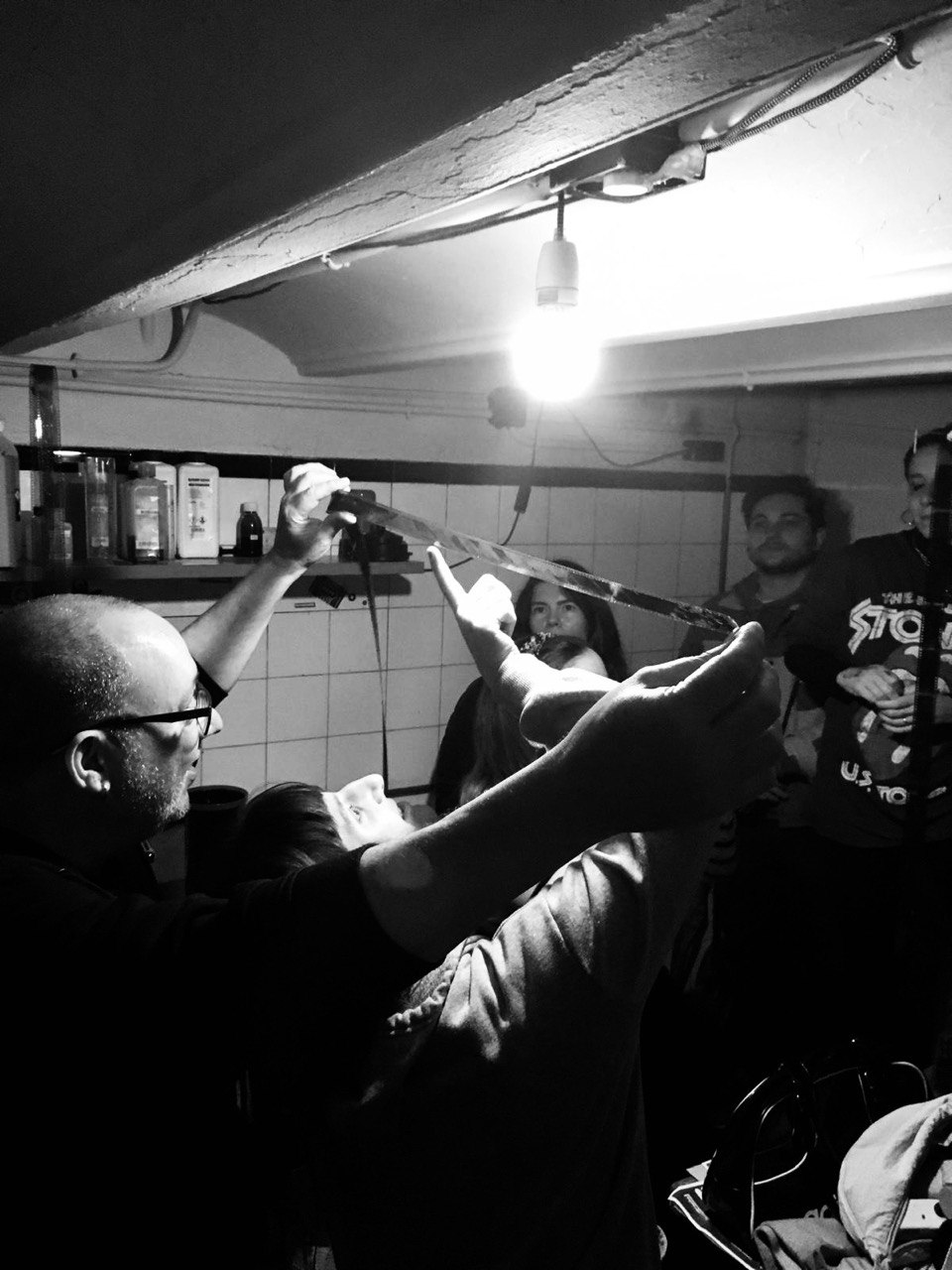
Working in photography means never stopping the research: new developing formulas, experimental techniques, new surfaces — including glass —, new results. And keeping close contact with creators from both similar and very different fields. He still gets moved watching an image appear magically while developing. And even more so, seeing the faces of people who have never witnessed it in person: the smell of the chemicals, the red light, the shift from total darkness to the blinding burst of the strobes.
In 2011 he starts teaching workshops at the Lomography Embassy Barcelona, now Cameras & Films. In 2017, Llumàtics opens as its own school in the Poble-Sec neighbourhood. The pandemic moves the studio to Nau Bostik, in the north of the city, where it operates today.
He is self-taught and has learned alongside masters including Manuel Castro Prieto, Rubén Morales and Alfonso de Castro. He has taught classes and given talks on experimental photography in various spaces and contexts. In 2020 he founded 112 Books, an independent photobook publisher.
More about Joan Linux at about.pocallum.cat
The space
The darkroom is small but well designed. It has medium format and large format enlargers, comfortable sinks for paper developing, a fridge to keep paper and film in good condition, a negative drying cabinet, a glazing machine and all the chemicals needed to work in film and paper. Next to the darkroom there is a small studio with paper backdrops and quality strobes.
We also have a small but very interesting library: a collection of books on authors and photographic techniques, available to students.
The space is a working studio, not a showroom. Visits by appointment only.
How we think about photography
Photography has two inseparable parts.
The technical side is learned through a solid theoretical foundation and a lot of practice. There are no shortcuts: you need to understand light, chemistry, the relationship between exposure time and developing temperature. We are rigorous here, and theoretical when needed — we’re actually writing a rather theoretical book on graphic editing in the publishing world.
The conceptual side comes from all existing arts and needs to be watered and cultivated every day. We always recommend seeing exhibitions — of any kind, not necessarily photographic —, reading a lot, looking at author books, buying photobooks (112books.eu is a good place to start), and doing what we call forensic analysis: stopping in front of any photograph that catches your eye and asking yourself why.
Documentary and street photography interest us a great deal, especially from a conceptual standpoint: as a form of communication, not as technical display.
We didn’t come from fine arts school. But we have taught classes and given talks on experimental photography in many different contexts. And we’re still learning.
Groups of maximum 4 people isn’t a capacity limit — it’s a pedagogical condition. When learning chemical photography, individual attention isn’t a luxury, it’s the minimum.